Every growing business eventually hits a wall where the equipment that once felt like plenty starts holding things back. Orders pile up, lead times stretch, and the gap between what customers want and what your line can deliver gets harder to ignore. Deciding whether to upgrade production equipment is rarely simple, since the costs feel immediate while the payoff feels uncertain.
This article breaks down the signs, the math, and the practical steps that help you figure out when an upgrade actually pays off at scale.
Recognizing the Signs Your Line Has Maxed Out
Most manufacturers do not wake up one day and decide to overhaul their production line. The decision usually builds slowly, through missed delivery dates, rising overtime costs, and machines that need constant babysitting to keep running. If your team is spending more time troubleshooting than producing, that is a strong signal the equipment has reached its practical ceiling. Recognizing these patterns early gives you more options and more negotiating power when it comes time to invest in new capacity.
- Production delays that keep recurring despite process tweaks
- Maintenance costs climbing faster than output
- Quality defects increasing as machines age
- Staff overtime becoming a permanent fixture rather than an exception
- Customers asking for volumes you cannot realistically promise
Calculating the True Cost of Standing Still
It is tempting to view an equipment upgrade purely as an expense, but that framing misses half the picture. Standing still has its own cost, measured in lost orders, rushed shipping fees, and customers who quietly move to competitors who can scale faster. A useful exercise is to calculate what a single missed contract or delayed shipment costs you in revenue and reputation, then compare that figure against the price of new equipment spread over its useful life. When you run the numbers this way, many businesses find that inaction is the more expensive choice.
It also helps to look at indirect costs that rarely show up on a simple spreadsheet. Older machines tend to consume more energy, require pricier replacement parts, and sit idle longer when something breaks because fewer technicians know how to fix them. Those hidden expenses accumulate quietly until they rival or exceed the cost of a planned upgrade.
Matching Equipment Investment to Real Demand
Not every business needs the fastest, most advanced machinery on the market, and buying more capability than you need can strain cash flow without delivering a matching return. The smarter approach is to map your current demand trends against realistic growth projections for the next two to five years. This helps you size an upgrade correctly instead of overbuilding for volumes that may never materialize or underbuilding for growth that is already visible in your order book.
- Review at least two years of order history to spot seasonal and growth patterns
- Separate one-time demand spikes from sustained increases
- Talk to your sales team about pipeline deals that could affect future volume
- Compare equipment capacity against your realistic three-year forecast
- Build in a reasonable buffer without overshooting your budget
Weighing Automation Against Manual Processes
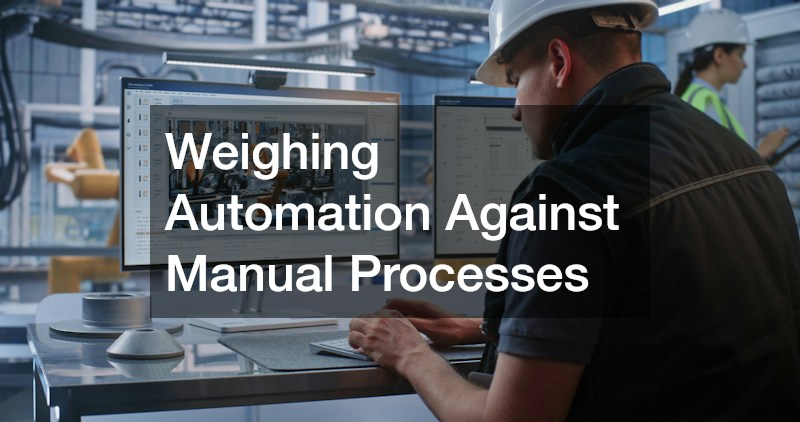
One of the biggest decisions in any equipment upgrade is how much of the process to automate versus keep manual. Automation tends to pay off fastest in repetitive, high-precision tasks where consistency matters more than flexibility. A good example is robotic welding, which can dramatically improve throughput and reduce defect rates on parts that require the same weld pattern thousands of times over. Businesses that make this switch often find that the consistency gains alone justify the investment, since fewer reworks mean less wasted material and labor.
That said, automation is not automatically the right answer for every process on your line. Tasks that require frequent changeovers, custom specifications, or human judgment may still be better served by skilled workers, at least until volume justifies a dedicated automated cell. The goal is to match the right tool to the right task rather than assuming more automation always equals more scale.
Planning the Transition Without Disrupting Current Orders
Even the best equipment upgrade can backfire if it disrupts the orders you already have in progress. A phased rollout, where new equipment is installed and tested alongside existing lines before the old setup is retired, reduces the risk of a painful production gap. Training staff on new machinery before it becomes mission critical also prevents the slowdown that often follows a rushed changeover. Businesses that plan transitions carefully tend to see a much faster return to full output than those that attempt a complete swap overnight.
- Schedule upgrades during historically slower demand periods when possible
- Run parallel production during the transition to catch issues early
- Train operators on new equipment before old machines are decommissioned
- Keep a contingency plan for fulfilling orders if installation runs long
- Communicate timelines clearly with customers who may be affected
Measuring Return on a Completed Upgrade
Once new equipment is running, it is worth setting a clear timeline for measuring whether it delivered the results you expected. Most manufacturers find a 90-day window gives enough production cycles to smooth out the learning curve, while a 6- to 12-month review shows whether gains are holding steady under normal demand swings. Set both checkpoints in advance, so the evaluation doesn’t quietly slip once daily operations take over. Tracking metrics like units produced per hour, scrap rate, and labor cost per unit before and after the upgrade gives you concrete evidence of impact rather than a gut feeling. Downtime frequency and changeover time are worth watching too, since a faster machine that breaks down more often or takes longer to switch between product runs may not be the net win it appears to be on paper.
Where possible, compare these numbers against the projections used to justify the purchase, so you know whether you’re ahead of, on pace with, or behind the original business case. This data also becomes valuable the next time you need to justify a capital investment to lenders, partners, or your own leadership team. A documented track record of upgrades that paid off — with real figures attached — makes future financing conversations faster and strengthens your credibility when asking for larger sums. Treating the upgrade as an ongoing measurement exercise, rather than a one-time purchase, helps you catch underperformance early and adjust before small issues become expensive ones. If throughput stalls below target after the first quarter, that’s the moment to investigate operator training, maintenance schedules, or upstream bottlenecks — not six months later when the shortfall has compounded across thousands of units.
Conclusion
Upgrading a production line is rarely about chasing the newest technology for its own sake, it is about matching your equipment to the scale you are actually trying to reach. Start by honestly assessing where your current line is struggling, then run the numbers on what standing still is really costing you. From there, a phased, well measured upgrade can turn a bottleneck into the foundation for sustainable growth.